Monday, April 15, 2013

Judgement: The Communist Manifesto


Title: The Communist Manifesto
Date: 1848
Nationality: United Kingdom
Creator: Karl Marx
Medium: Print


“The distinguishing feature of Communism is not the abolition of property generally, by the abolition of bourgeois property.  But the modern bourgeois private property is the final and most complete expression of the system of producing and appropriating products, that is based on class antagonism, on the exploitation of the many by the few” 
--Karl Marx, The Communist Manifesto (Strong and Davis 571).

The learning application of judgment is rarely seen with more clarity than in Karl Marx’s Communist Manifesto.  The industrial revolution was in full swing and laissez faire capitalism was demonstrating its inherent inconsistencies—the rich became richer, the poor became poorer, working conditions worsened, and frequent economic recessions meant that “up to half of all workers could find themselves out of work” (Strong and Davis 552).  Moreover, the awful conditions began to inspire the people to recognize a violation of their human rights.  Marx, aware of the conditions around him, began to assess the causes of society’s apparent failure to provide and protect the majority of its people.  In doing so, he judged the inherent weaknesses of capitalism and the impending progression of class warfare.  He did this partly by taking the Hegelian idea of historical progression, categorized the basic schema to be true, but rejected the substance—where Hegel saw the world as a history of the struggle of ideas, Marx saw the world as a history of the struggle of economic and social classes.  Thus, out of his judgments regarding the social conditions and philosophies of his day, Marx was able to develop his own theory of socio-economic development and action as well as project it into the future.  This ability to discern and evaluate society’s path into the future is a lesson that all must learn—particularly a civilization hoping to establish itself with security.

Image taken from: http://nsi-delhi.blogspot.com/2013/02/celebrating-165th-year-of-communist.html

Judgement: Brave New World

Title: Brave New World
Date: 1931
Nationality: United Kingdom
Creator: Aldous Huxley
Medium: Print

“But I don’t want comfort.  I want God, I want poetry, I want real danger, I want freedom, I want goodness. I want sin.” 
“In fact,” said Mustapha Mond, “you’re claiming the right to be unhappy.”
“All right then,” said the Savage defiantly, “I’m claiming the right to be unhappy.”
“Not to mention the right to grow old and ugly and impotent; the right to have syphilis and cancer; the right to have too little to eat; the right to be lousy; the right to live in constant apprehension of what may happen tomorrow; the right to catch typhoid; the right to be tortured by unspeakable pains of every king.” There was a long silence. 
“I claim them all,” said the Savage at last.
Mustapha Mond shrugged his shoulders.  “You’re welcome,” he said.
--Aldous Huxley, Brave New World (Strong and Davis 731).

The First World War was over and new regimes were growing through continental Europe—totalitarian powers such as Soviet Russia and Nazi Germany.  The “war to end all wars” had left Europe a smoldering ruin and its people in a state of depression and uncertainty.  In exchange for promises of security and succor, many were drawn to the allure of these growing empires—peace was perceived in strength.  Aldous Huxley, sensitive to the conditions of the world around him, discerned what was happening and brought to bear the ideas precipitating the new powers under his keen judgment.  He saw that ultimate ends industrial and scientific revolutions were transforming society into a machine focused on results and efficiency.  Huxley categorized this negatively—contrary to the opinions of many, he believed that a world of perfect stability and peace, a world where all wants are satisfied, a world without art or passion—he judged such a world to be meaningless.  And so, he struck “a blow against totalitarianism” and argued for the “value of art for the soul” within his work, Brave New World (Strong and Davis 721).

The story of Brave New World is set within a future dystopia where science has become the means to unassailable social stability.  Genetic selection and oxygen depletion are used to create a society of classes where each individual is capable of performing and enjoying his or her place within the greater whole of society.  Any discontent is systematically extinguished through drugs and instant sensual stimulation.  It is a world without conflict, and so, it is a world without worth, according to Huxley.  Throughout the book, Huxley repeatedly raises every argument for such a calculated society and then judges them to be utterly hollow. This kind of judgment is essential to learning—for it creates the grounds for whole concepts that will guide present and future action. 

Discernment: Impression, Sunrise


Title: Impression, Sunrise
Date: 1872
Nationality: France
Creator: Claude Monet
Medium: Painting


In the midst of the Romantic era, a handful of French artists found themselves liberated from the confines of their studios by the invention of oil paints stored in tubes and free to create their paintings in the midst of the outside world.  In their new environment, they were exposed to the changing light of day and became “obsessed with capturing the moment” (Strong and Davis 664).  Where the paintings of previous eras emphasized message, clarity, technicality, and emotion, Claude Monet’s Impression, Sunrise, became the staple of the Impressionist movement as a brilliant example of a newly found way to perceive the world—the “indistinct” and “instantaneous” nature of a single moment (Strong and Davis 664).  Changing light and the constantly shifting perception of nature was not a new phenomenon of the day—human experience did not change in the second half of the 19th century—yet no one in Europe had been sensitive enough to discern these aspects of experience until the Parisian impressionists stumbled serendipitously out of the shadows.  In the world around us, there is much we take no notice of at all, Impression, Sunrise demonstrates the profundity of what goes ignored for ages. 

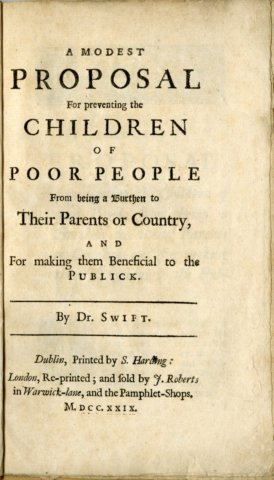
Discernment: A Modest Proposal


Title: A Modest Proposal
Date: 1729
Nationality: United Kingdom
Creator: Jonathan Swift
Medium: Print 

I have been assured…that a young healthy child well nursed, is, at a year old, a most delicious nourishing and wholesome food, whether stewed, roasted, baked, or boiled; and I make no doubt that it will equally serve in a fricasie, or a ragoust.  I do therefore humbly offer it to publick consideration, that of the hundred and twenty thousand children…that the remaining hundred thousand may, at a year old, be offered in sale to the persons of quality and of fortune...
Jonathan Swift, A Modest Proposal (Strong and Davis 404).
Jonathan Swift (1667—1745) was a political satirist who was highly sensitive to his surrounding conditions.  His home, Ireland, at the period of his life was steeped within the injustices laden upon it by England—poverty, illness, and hunger were staples of the Irish condition.  In order to draw attention to the impoverished conditions, Swift created one of the greatest and most influential satirical pieces in history by using the logical and scientific vernacular of his day to create a proposal so outrageous, yet so sincere and sober minded that “readers are immediately aghast at what has been proposed”—the use of Irish infants for food and raiment of the English elite (Strong and Davis 395).  Swift’s great gift was his depth of discernment.  He saw all at once the awful condition of the poor, the indifference of the rich, and the obsession with the Enlightenment principles that permeated the political atmosphere of his day.  Identifying these things allowed him to craft a document addressing his audience and compel greater discernment on their part as well.  This acute discernment of the conditions of life and society, particularly those of the poor, will be necessary for a new society to learn, to progress, and to thrive, and most importantly—to be just.

Image taken from: http://en.wikipedia.org/wiki/A_Modest_Proposal